
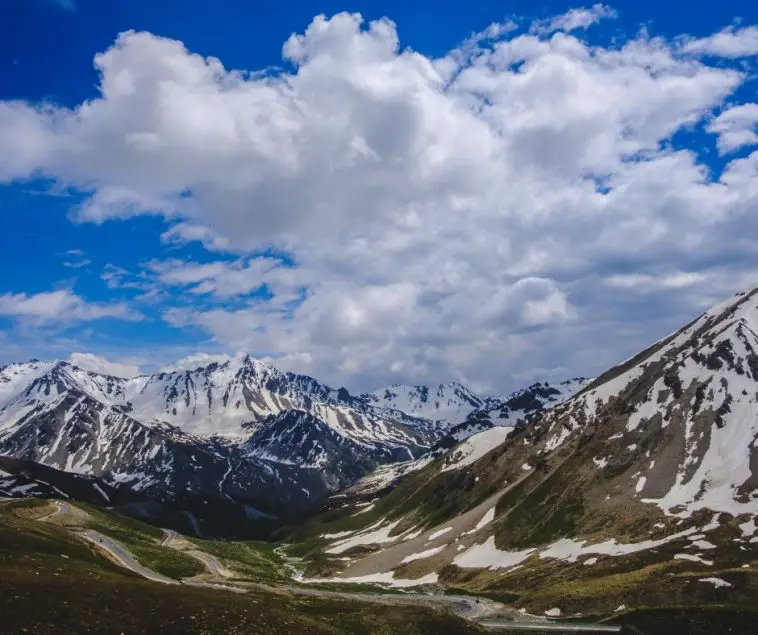
The Tien Shan Mountains are one of the longest mountain ranges in Central Asia. They offer breathtaking views that have captivated and inspired many people.
The towering peaks and rolling grasslands also provide a refuge for local wildlife, including species like snow leopards and Marco Polo sheep.
The range is home to some of the region’s most pristine lakes and rivers, providing abundant water resources to nearby towns and cities.
And, of course, the range is known for its unique microclimates, from lush meadows close to sea level to the harsh subarctic climate found on its summits.
Apart from being a geographic marvel, the Tien Shan Mountains are also steeped in culture and history. Local legends paint it as the home of gods and fairies, while travelers have long seen it as an entrancing destination with plenty of adventure potential.
If you’re looking for a place to explore, far away from conventional tourist traps but with countless stories to tell, then consider adding the Tien Shan Mountains to your list.
Tien Shan Mountains Facts for Kids
- The Tien Shan Mountains are a mountain range in Central Asia.
- They stretch over 2,500 miles (4,000 kilometers).
- The Tien Shan Mountains are home to many species of plants and animals.
- The highest peak is Victory Peak, at 24,406 feet (7,439 meters).
- The Tien Shan Mountains are an important source of water for the region.
- The mountain range is home to many ski resorts and other outdoor recreational activities.
History of the Mountains

Conceptually, the Tien Shan Mountains have a lot of historical significance. According to Yan Shigu, a Tang Dynasty commentator, one of the earliest known references to these mountains connect them to the Xiongnu word “Qilian,” which means “sky” or “heaven.” Sima Qian further referenced these particular mountains as the ancestral homeland of the Yuezi in his work “Records of Grand Historians.”
The name itself seems to support this theory as it can mean either “God/Spirit Mountains” or “Heaven/Celestial Mountains” in various dialects. Khan Tengri is also located within these mountains and translates as “Lord of the Spirit.” This mountain range is even considered sacred by the ancient religion Tengrism.
This level of importance is indeed justified since, in 2013, parts of the Tien Shan Mountains standing on Chinese territory were included in UNESCO’s World Heritage List, followed by that Kyrgyzstan, Kazakhstan, and Uzbekistan three years later.
Overall speaking, it’s no wonder why this area has been able to retain its symbolism throughout centuries – from these perspectives, both historical and spiritual – making it truly unique and worthy of all its recognition.
Where are the Mountains
The Tien Shan mountain range has a unique geography, bridging two of the most iconic mountain formations on the continent. It is located at the intersection of several Eurasian countries and was formed by devastating plate tectonics activity.
The collision of the Indian and Eurasian plates in the Cenozoic Era created an unmistakable landscape, a part of the greater Himalayan Orogenic Belt. It stands as a testament to this catastrophic event, and its grandeur is much admired by onlookers.
This impressive formation serves as an integral feature in Central Asia, connecting majestic mountains like the Pamir Mountains with the Mongolian Altai Mountains to its north and east. Its enormity is breathtaking, and its influence won’t be forgotten anytime soon.
The Wonderful Mountain Ranges
Conceptual innovation in the Tien Shan Mountains offers an impressive and memorable landscape. There is no other mountain range quite like it, with its range of towering peaks and deep valleys extending from Uzbekistan to Central Asia.
Even more remarkable is the Turfan Depression, which contains the lowest point in Central Asia at a depth of 505 meters below sea level.
Moreover, amongst these peaks lie several iconic ranges such as Barkol Mountains, Borohoro Mountains, and the mighty Dzungarian Alatau in the northern part.
These ranges come together to create intricate connections between valleys and basins without fail, truly making this an unforgettable sight for any curious soul.
Besides physical landmarks, the Tien Shan Mountains also have namesakes within their gigantic expanse – from U-shaped Barkol Mountains to God Mountain’s Bogda Shan.
It’s an area nearly twice the size of Austria, one which continues to reveal new fascinating aspects all the time—speaking volumes about this magnificent array of geology and natural beauty.
It may seem overwhelming; important details are amassed around a vast region that makes up half of the Central Asian terrains.
Yet there is hope — as one takes immense delight in exploring all that lies here —from overviews to unique features, as well as its notable landmarks and majestic mountains all waiting to be discovered.
The Ecology

The Tien Shan Mountains offer a home to some of the most diverse life on earth, both in terms of animal and plant life. Its continental climate results in dramatic temperature extremes, and that helps create ideal conditions for a variety of species to thrive.
The mountains are blessed with extreme temperatures below 32 °F, around 2500 hours of sunshine each year, plentiful precipitation in winter and south-western regions, and deciduous trees typical of temperate climates – maple, aspen, pistachio, and walnut, to name a few.
Wildlife ranges from cold-weather species such as wolves and foxes, redstart birds, and snow leopards in the highlands to antelopes, gazelles, hares, and hamsters on the lower plains. Reptiles, too, can be found skittering among the rocks.
And between them all lies an abundance of xerophytic grasses, wormwood, and ephedra – delicate vegetative growths that appear every spring before disappearing with summer’s arrival. It’s true what they say; the climate is everything.
Here are some of the best places to visit in the mountains
Kyrgyzstan and its surrounding regions are awash with scenic beauty, and each destination boastings its own awe-inspiring sights. The one true standout, however? The mighty Syr Darya River.
Connecting two countries and winding through countless other fascinating destinations, its history is as long as its journey–which stretches 2,256.25 kilometers across Uzbekistan and southern Kazakhstan.
Deep within the Tien Shan Mountains in Kyrgyzstan lies the Ili River, a stunning 815-kilometer river that flows from China to Kazakhstan’s Almaty Region. Its basin is formed between the Borohoro and Tien Shan mountains, granting visitors an unforgettable landscape like no other.
Perched high up in the mountains lies Jengish Chokusu–the tallest mountain in the Tien Shan range at 24,406 feet of elevation. This major landmark can be found between Wenshu County in China and Ak-Suu District in the Eastern Kyrgyz region of Issyk-Kul.
Not too far away lies Khan Tengri, the second-highest summit at 22,999 feet with a natural elevation of 22,949 feet which forms a tripoint of three different countries! Such splendor truly deserves attention!
Some Fun Facts
The Tian Shan, stretching across Central Asia’s border with China and Kyrgyzstan, is an impressive system of mountain ranges.
With their majestic peaks and extraordinary biodiversity, it is far from a surprise that the eastern part of these ranges was granted UNESCO World Heritage Site status in 2013.
Extending further into Kazakhstan, Uzbekistan, and Kyrgyzstan, they earned another recognition in 2016 as the western portion became a designated World Heritage Site.
Not only do these mountains provide intense beauty and adventure to those who explore them – but they have also served humanity for millennia as part of the North Silk Road for travelers between East Asia and the Middle East as it stretched across the vast Taklamakan Desert.
There’s something special about standing next to these massive stones surrounded by frozen desert landscapes in Central Asia – an experience well worth having at least once in your life.