
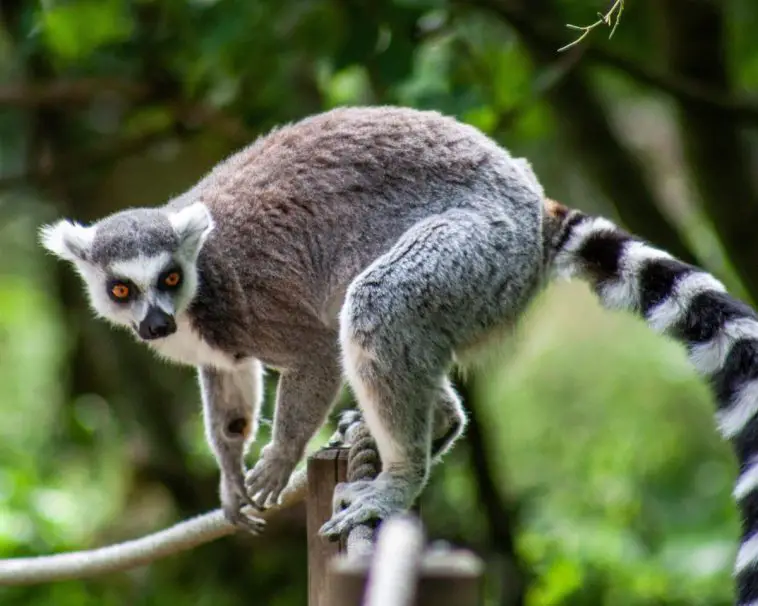
The black and white rings adorning their tails are one of the most recognizable features of the ring-tailed lemur, a species that has captured the imagination of many thanks to King Julien’s presence in the Madagascar movies. But there’s much more to these fascinating creatures than just their appearance.
Ring-tailed lemurs are unique in that they spend a significant amount of time on the ground – in fact, more than any other species of lemur. They’re also known for their love of sunbathing, often stretching out their limbs in a posture that resembles worship. In the wild, these fascinating creatures can live for up to 15 years, making them one of the longest-living lemur species.
But there’s something else that sets ring-tailed lemurs apart: their grey body fur, which is contrasted by white faces and chests. This combination of colors creates a striking visual that makes these creatures stand out in their natural habitat. It’s no wonder they’re one of the most beloved lemur species in the world.
Perhaps it’s their unique appearance, their sun-loving habits, or their longevity that has captured the public’s imagination. Whatever the reason, there’s no denying that ring-tailed lemurs are a fascinating species that deserves our attention and admiration. With their striking appearance and interesting habits, it’s no wonder they’ve become one of the most recognizable and beloved types of lemurs in the world.
Lemur Facts for Kids
- Lemurs are primates found only in Madagascar.
- Over 100 different lemur species exist.
- They have bushy tails and big eyes.
- Lemurs are social animals living in groups.
- They communicate with scent and sounds.
- Lemurs mainly eat fruit, leaves, and insects.
- Many lemur species are endangered.
Conservation

The ring-tailed lemur, a beautiful and charismatic primate, is sadly endangered in the wild. Despite their ability to breed well in captivity, the number of ring-tailed lemurs in zoos cannot make up for the loss of their wild populations. These creatures face a daunting array of threats, including habitat destruction, hunting for their meat, and the illegal pet trade.
Habitat destruction is perhaps the most significant threat to ring-tailed lemurs. As their forest homes are destroyed for timber, agriculture, and mining, the lemurs lose their food sources and shelter. This loss of habitat fragments the population and separates family groups, making it more difficult for the lemurs to reproduce and thrive.
Sadly, ring-tailed lemurs are also hunted for their meat. In some areas, they are considered a delicacy and are sought after by hunters. This hunting activity is harmful to the lemurs’ survival, and it is essential to address the issue by enforcing wildlife protection laws and educating people about the risks associated with hunting.
Another major threat to ring-tailed lemurs is the illegal pet trade. Many people are willing to pay large sums of money to own these exotic animals as pets. This demand encourages the theft of lemurs from the wild, which is devastating for their populations. It is crucial to spread awareness about the negative impacts of the pet trade and discourage people from buying or selling these animals.
In conclusion, the ring-tailed lemur faces severe threats to its survival, including habitat destruction, hunting, and the illegal pet trade. We must take collective action to protect these beautiful creatures before it’s too late. It’s our responsibility to ensure the conservation of the species and secure a future for these primates in the wild.
Ring-tailed lemur questions and answers
Where do ring-tailed lemurs live?
Ring-tailed lemurs hail from the exotic island of Madagascar, situated off the East Coast of Africa. These marvelous creatures thrive in the lush rainforests of the island, where they spend most of their time on the forest floor, relishing in all the forest has to offer.While they are proficient climbers, preferring to spend their time in the mid-canopy, they are not often found at the very top of the trees like their ruffed lemur counterparts. These delightful creatures are social beings, usually found in groups of up to 25 members, making them a delightful sight to behold.
Their diet is varied, consisting of primarily fruits, but they do enjoy a good helping of leaves, flowers, and even insects. This diet has enabled them to adapt to their surroundings, making them one of the most successful lemur species, and a joy to watch in the wild.
Their habitat is crucial to their survival, as they rely on the forest floor for their food sources and protection from predators. They prefer to live in the dry deciduous forests of southwestern Madagascar, where they can easily find their preferred foods.
Ring-tailed lemurs are unique creatures, constantly engaging in social interactions with each other. They are known for their distinct vocalizations, which they use to communicate with their group members. Their social skills have been the subject of many studies, which has led to the discovery of their complex social structures.
What do ring-tailed lemurs eat?
Ring-tailed lemurs have a unique diet that sets them apart from other lemurs. These primates are particularly fond of fruit, with a preference for the tamarind tree’s leaves. In fact, when tamarind leaves are available, half of the ring-tailed lemur’s diet consists of them!Interestingly, the reason for their unique diet is due to the amount of time they spend on the ground. Unlike other lemur species, ring-tailed lemurs will also eat bark, earth, small insects, and even spider webs. This diverse diet helps them survive in their natural habitat.
It’s fascinating to observe the ring-tailed lemurs’ eating habits, especially when they forage for their food. They have a keen sense of smell and can detect fresh fruit from a distance. Once they locate a food source, they use their hands to pluck the fruit or leaves and then use their teeth to break it down into smaller pieces.
It’s also worth noting that ring-tailed lemurs have a unique digestive system that allows them to extract as many nutrients as possible from their food. Their stomachs have four compartments that help them break down fibrous plant material and extract essential nutrients.
Overall, the ring-tailed lemur’s diet is incredibly diverse and well-suited to their environment. Their preference for fruit and leaves, along with their ability to eat a variety of other food sources, ensures their survival in their natural habitat. It’s truly remarkable how these primates have adapted to their surroundings and developed such a unique and fascinating diet.
What is a group of ring-tailed lemurs called?

Did you know that a group of ring-tailed lemurs is often referred to as a troop? These adorable primates, native to Madagascar, are known for their distinctive black and white striped tails and their playful nature. In the wild, lemurs live in groups of up to 30 individuals and are highly social creatures.Observing a troop of ring-tailed lemurs is a magical experience. These curious creatures can be seen grooming each other, playing games, and basking in the sun. They are also known for their unique vocalizations, which range from grunts and screams to purrs and clicks.
Ring-tailed lemurs are an important part of the ecosystem in Madagascar. They play a vital role in spreading seeds and pollinating flowers, helping to maintain the delicate balance of the island’s unique flora and fauna. Unfortunately, these amazing animals are also facing significant threats, including habitat loss and hunting.
To help protect ring-tailed lemurs and their habitat, conservation organizations are working to raise awareness about these incredible primates. By educating the public about the importance of preserving Madagascar’s biodiversity and supporting local communities, we can all play a role in ensuring that these animals thrive for generations to come.
So the next time you see a group of ring-tailed lemurs at the zoo or in the wild, take a moment to appreciate these remarkable creatures. They are a testament to the beauty and diversity of our planet’s wildlife and a reminder of the critical role we all play in protecting it.
What noise do ring-tailed lemurs make?
Ring-tailed lemurs are known to be quite vocal creatures, emitting a variety of sounds that range from loud wails to soft purrs. These sounds are used to communicate with other members of their group, warning them of potential threats or expressing various emotions such as fear or excitement.
One of the most distinctive sounds that ring-tailed lemurs make is the alarm call, which is a loud and piercing wail that is used to alert other members of their group of potential danger nearby. This call is typically heard when predators such as hawks or snakes are spotted, and it serves as a warning to other lemurs to keep a safe distance.
Apart from alarm calls, ring-tailed lemurs also emit soft chirps and purrs when they are content or in a social setting. These sounds are used to maintain social bonds with other members of their group and to express their friendly intentions. Furthermore, during the breeding season, male lemurs will also make a series of grunts and howls to attract females and establish their dominance over rivals.
Overall, the sounds that ring-tailed lemurs make in the wild are an essential part of their communication system, allowing them to interact with each other and navigate their surroundings. Understanding their vocalizations is also important for researchers and conservationists who are working to better understand and protect these fascinating primates in the wild.
How many types of lemurs are there?
Lemurs, oh how fascinating they are! Did you know that there are nearly 100 different types of lemurs that exist? And guess where they all come from? Madagascar! It’s truly amazing how one island could be home to so many diverse species.But don’t let their small size deceive you. The pygmy mouse lemur, the smallest of the bunch, weighs just one ounce! Can you even imagine how tiny that is?
Now, let’s clear up a common misconception. Lemurs are often mistaken for monkeys, but in fact, they are not. Although they share some similarities, such as being part of the primate order, which includes ‘monkeys’, ‘prosimians’, and ‘apes’, lemurs are actually prosimians. And did you know what that means? It means ‘before monkeys’, how interesting is that?
As fascinating as they are, lemurs are unfortunately endangered. Habitat destruction, hunting, and climate change are just some of the major threats to their survival. It’s important that we take action to protect these unique and wonderful creatures.
But let’s not forget to appreciate their beauty and wonder. From the ring-tailed lemur with its distinctive black and white striped tail to the aye-aye with its long slender fingers, each one holds its own charm.
So the next time you come across a lemur, take a moment to appreciate just how incredible they are. And remember, there’s a whole world waiting to be discovered, and each species holds its own unique beauty.
How many babies does a ring-tailed lemur have?
Ring-tailed lemurs typically give birth to a single offspring, with the occasional occurrence of twins. These adorable primates are known to be excellent parents, with mothers carrying their precious little ones on their chests or backs. It’s truly a sight to behold, as the baby clings tightly to its mother’s fur while she navigates through the trees with ease.In the wild, lemurs typically give birth during the rainy season when food is abundant. This ensures that the mother has plenty of nourishment to help care for her offspring. After giving birth, the mother will spend a lot of time grooming and cuddling her baby, helping to create a strong bond between them.
As the baby grows older, it will become more independent and start exploring its surroundings. However, it will still rely on its mother for protection and guidance. In fact, ring-tailed lemur mothers are incredibly attentive and will keep a watchful eye on their offspring at all times, even going so far as to carry them away from potential threats.
Interestingly, group members will often help care for the baby as well. This communal approach to raising young ensures that the little one is always surrounded by a supportive and loving network. As the baby becomes more mobile, it will start to interact more with the other lemurs in the group, playing and learning from them.
It’s incredible to see how much love and care goes into raising a ring-tailed lemur baby. These gentle creatures have a strong sense of community and family, and it shows in the way they raise their young. Watching a mother interact with her baby is truly heartwarming and reminds us of the importance of love and nurturing in our own lives.