
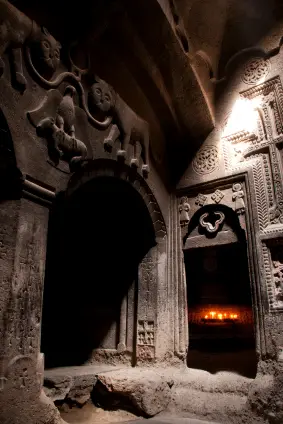
In the hills of Armenia lies a monastery that has been there for almost 2,000 years. The Monastery of Geghard was a monastery built by Christian monks in the 4th century. Some of the monastery was cut right out of the rock. Other parts were made from cut rock. The monastery is most famous because it held ancient relics, including the sword that pierced Christ’s side and relics of the apostles John and Andrew.
Christian Orthodox Tradition
Known as the Kiev Pechersk Lavra or the Monastery of the Cave, this historical monastery holds a significant place in the Christian Orthodox tradition and is regarded as one of the most sacred spiritual centers of Eastern Orthodox Christianity.
Founded in the 11th century, it is renowned for its network of subterranean caves which served as the dwelling and burial sites for hermit monks. These monks, who are revered as saints, dedicated their lives to prayer and asceticism.
The monastery also preserves sacred relics and icons, believed to possess miraculous powers, attracting thousands of pilgrims annually. Therefore, with its rich history and spiritual significance, the Monastery of the Cave stands as a symbol of the endurance and resilience of Orthodox Christianity.
Sacred Religious Sites
The Monastery of the Cave, also known as the Kiev Pechersk Lavra, is a revered sacred religious site in Eastern Orthodox Christianity, boasting an emblematic status due to its rich historical significance and deep-rooted spirituality. Situated on the hills of Kiev, Ukraine, the historic monastery complex serves as an impressive showcase of medieval architecture.
It gets its name from a series of caves which were once the dwelling and worshipping places of monks, now transformed into a labyrinth of narrow tunnels housing the mummified remains of the monastery’s earliest monks, whom Orthodox tradition honors as saints.
The golden-domed churches and bell tower of the monastery serve as potent symbols of spiritual devotion, drawing pilgrims from around the world. This aura of spirituality and tranquility, coupled with its historical importance, makes the Monastery of the Cave a vital sacred religious site.
Caves and Spiritual Retreats
Located in the heart of Ukraine, the Monastery of the Cave, also known as the Kiev Pechersk Lavra, symbolizes a unique convergence of natural caves and spiritual retreats. Founded originally as a secluded refuge for monks seeking solitude and prayer, these caves were their homes, prayer cells, and even burial sites, thus creating a distinctive spiritual microcosm.
The monastery, which was established within these caves, now serves as a tranquil spiritual retreat for visitors across the globe. It offers an experience of reverence and spiritual enlightenment within its ancient walls, echoing a centuries-old tradition of cave-based spiritual retreat.
Today, the Monastery of the Cave remains a significant landmark, harmoniously blending religious history, architectural magnificence, and spiritual retreat, continuing to be a testament to the monks’ initial pursuit of secluded devotion.
Religious Pilgrimage Destinations
The Kiev Pechersk Lavra, or the Monastery of the Cave, in Ukraine, is a revered religious pilgrimage location deeply rooted in Eastern Orthodox Christianity. This significant site offers a unique spiritual journey through its intricate network of subterranean caves, where monks once lived and were later entombed.
The complex is also home to an array of ornate churches and cathedrals, adorned with golden domes, intricate frescoes, and precious religious relics, reflecting the rich history and tradition of Orthodox Christianity since its founding in the 11th century.
A pilgrimage to this spiritual sanctuary, which has been recognized as a UNESCO World Heritage Site, provides devotees a chance to reflect, pray, and deepen their understanding of their faith in an environment that has been a haven for spirituality for centuries.
Ancient Frescoes and Iconography
The Monastery of the Cave, otherwise known as Kyiv Pechersk Lavra in Ukraine, is a treasure trove of ancient frescoes and iconography dating back to the 11th century. This religious establishment boasts a complex network of underground caves which are intricately decorated with religious art that echoes Byzantine and Ukrainian Baroque styles.
The captivating artwork, depicting biblical scenes, portraits of saints, and various religious symbols, provides a remarkable perspective into the spiritual and artistic traditions of early Christianity in Eastern Europe.
The monastery’s crucial role in preserving these ancient pieces has greatly contributed to the study of Christian iconography, making it a must-visit destination for historians, art lovers, and religious scholars. Essentially, the Monastery of the Cave is a living testament to the region’s rich religious heritage, wrapped in a collection of ancient frescoes and iconography.
Ascetic Life and Monasticism
The Monastery of the Cave, or Kiev Pechersk Lavra, located in Ukraine, is a significant monument to the ascetic life and monasticism, having been established in the 11th century. It is well-known for its underground cave system that historically provided a sanctuary for monks seeking solitude for spiritual discipline, devoid of worldly distractions.
These subterranean chambers were the stage for an austere life of rigorous prayer, fasting, and contemplation, embodying a cornerstone of Christian monasticism. The monastery continues to bear witness to this tradition as it still houses monks who pursue the spiritual growth and ascetic practices of their predecessors.
History of Eastern Christianity
Recognized as a UNESCO World Heritage site, the Monastery of the Cave, or the Kiev Pechersk Lavra, is a significant symbol of Eastern Christianity with a rich history dating back to the 11th century. As one of the oldest monastic institutions in Eastern Europe, it is celebrated for its complex network of underground caves and catacombs that once served as a dwelling and burial place for monks.
Over the centuries, the monastery evolved into a central hub of Christian learning and spirituality, extending its influence across the Orthodox world, including Russia, Ukraine and other Slavic countries.
The development of Cyrillic literacy and Orthodox theology was significantly propelled by the crucial role played by the monastery’s libraries and scriptorium. Today, the Monastery of the Cave continues to stand as a testament to the rich history of the Eastern Orthodox Church.
Preservation of Religious Artifacts
Founded in the 11th century in Ukraine, the Monastery of the Cave, also known as the Kiev Pechersk Lavra, has played a pivotal role in safeguarding religious artifacts through its extensive network of underground tunnels and caves.
These have served as a sanctuary for religious icons, manuscripts, and relics, some dating back to the time of the monastery’s founding. The monastery’s museum now houses a vast collection of Orthodox Christian art and artifacts, reflecting the rich cultural and religious history of Eastern Europe.
Thus, the Kiev Pechersk Lavra is not just a place of worship, but also a vital institution for cultural preservation and historical research, underlining its profound commitment to the protection of these invaluable items.
Saints and Holy Relics
Renowned for its religious significance, the Monastery of the Caves, also called the Kiev Pechersk Lavra, has been a spiritual beacon since the 11th century. As the dwelling place of numerous Orthodox Christian saints who would later be canonized, this ancient monastery has played a pivotal role in religious history.
Beyond serving as a sanctuary for saints, the monastery also houses a sacred collection of holy relics in its underground labyrinth of caves. These relics, believed to hold miraculous powers, include the incorruptible bodies of the saints, attracting pilgrims worldwide in search of divine intervention and spiritual enlightenment.
Thus, the Monastery of the Caves stands as a symbol of faith, exemplifying the divine linkage between earthly life and spiritual transcendence.
Architecture of Monastic Complexes
The Kiev Pechersk Lavra, also known as the Monastery of the Cave, is an iconic monastic architectural complex exhibiting a harmonious integration of functionality, hierarchy, and symbolism. As a UNESCO World Heritage site in Ukraine, this complex was established in the 11th century and showcases a distinctive blend of Byzantine and Baroque architectural styles.
The monastery’s hierarchical layout includes multiple churches, cathedrals, bell towers, a seminary, and a library, all built on a series of caves – a clear representation of the spiritual ascension’s importance in monastic life.
The structures are adorned with golden domes, intricate frescoes, and ornate iconostasis, reflecting the era’s high craftsmanship level and artistic creativity. The caves function as both a place for spiritual contemplation and a burial site, further reinforcing the monastic principle of detachment from worldly life.
Thus, the Monastery of the Cave encapsulates the essence of monastic architecture in its structure, design, and purpose.

Fun Facts About the Monastery of the Cave for Kids
- Arabs destroyed the monastery in the 9th century. Monks rebuilt it.
- The main portion of the monastery is built in the design of a cross.
- The monastery has a dome.
- The monastery lies in a beautiful valley in the mountains.
- People still come here to visit.

Monastery of the Cave Vocabulary
- Monk: a religious scholar or priest
- Monastery: a large building that houses monks, religious writings and artifacts
- Ancient: old
- Pierce: cut, penetrate
- Relic: valuable possessions
All About the Monastery of the Cave Video for Kids
Watch this awesome Monastery of Geghard video for kids:
Monastery of the Cave Facts Q&A
Question: Where did the monks live?
Answer: The monks lived in small rooms that were cut out of the stone mountain.
____________
Question: Was the monastery comfortable?
Answer: The monastery is very dark inside because it is made of gray rock and there aren’t many windows. It was probably cold much of the year.
____________
Question: Why is the monastery called the Monastery of Geghard?
Answer: The monastery had thus been originally named Ayrivank, meaning “the Monastery of the Cave”. The name commonly used for the monastery today, Geghard, or more fully Geghardavank, which means “the Monastery of the Spear”. The name originates from the spear which had wounded Jesus at the Crucifixion.
Enjoyed the Earth Science for Kids about the Monastery of the Cave info? Take the FREE & fun all about the Monastery of the Cave quiz and download FREE Monastery of the Cave worksheet for kids. For lengthy info click here.